Why Every Construction Site Should Use Drone Surveys Before Groundbreaking
Why Every Construction Site Should Use Drone Surveys Before Groundbreaking
Are you still relying on manual surveying methods that take weeks and leave vast room for human error?
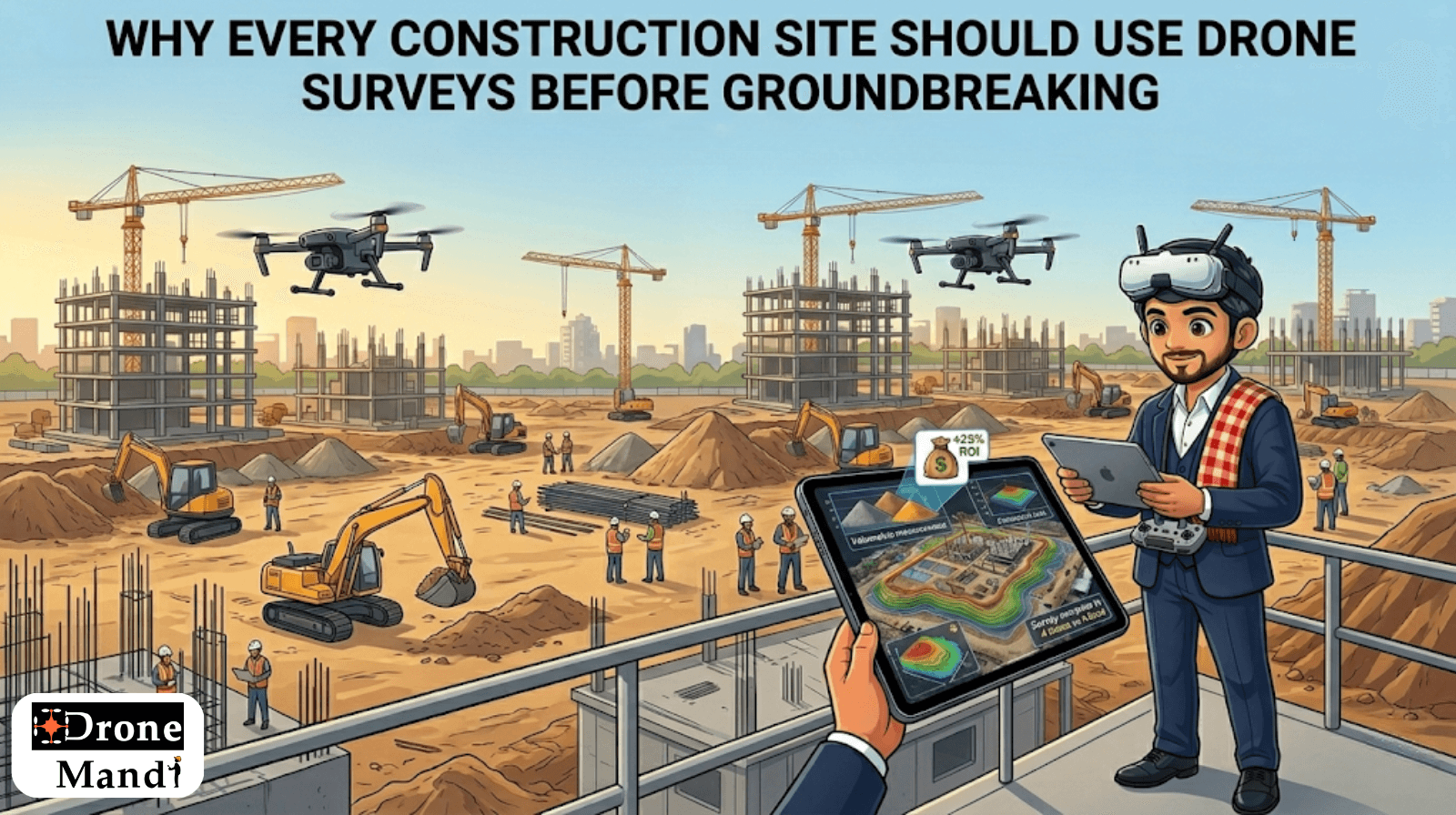
A construction site drone survey is no longer just a futuristic concept; it is the absolute industry standard for modern project management. In today’s fast-paced infrastructure sector, using drones for construction sites is rapidly replacing traditional ground-level checks. This technology slashes project timelines, boosts worker safety, and delivers highly accurate 3D topographic models in a fraction of the time.
Whether you need precise daily drone construction monitoring or volumetric stockpile analysis, aerial data is completely redefining site efficiency. Let’s dive deep into how drone surveys work, why they are essential, and how you can implement them seamlessly.
What is a Construction Site Drone Survey?
A construction site drone survey involves deploying Unmanned Aerial Vehicles (UAVs) equipped with high-resolution cameras and advanced sensors (like LiDAR or thermal imaging) to map, monitor, and inspect a construction zone. Instead of a ground crew spending days traversing hazardous terrain with GPS rovers, a single pilot can fly a UAV over the area to capture thousands of data points in minutes.
These data points are then processed into usable digital assets. The output includes orthomosaic maps, 3D point clouds, and Digital Elevation Models (DEMs). This comprehensive digital twin provides project managers, architects, and stakeholders with a highly accurate representation of the site’s physical conditions.
From pre-construction site mapping to final as-built documentation, drone survey mapping delivers an uninterrupted, reliable stream of visual and topographical data.
How Does Drone Construction Mapping Work?
Understanding the true drone survey meaning requires a look under the hood at the technology that makes it possible. UAVs do not just take pretty pictures; they capture intelligent, georeferenced data.
Here is the step-by-step process of how aerial vehicles are used in construction:
Flight Planning and Automation: The pilot uses specialized software to map out an autonomous flight path over the target area. The software determines the necessary altitude, image overlap, and camera angles based on the specific drone survey requirements.
Data Capture (The Flight): The drone flies the pre-programmed route, capturing hundreds or thousands of high-resolution images. It utilizes built-in RTK (Real-Time Kinematic) or PPK (Post-Processed Kinematic) GPS to ensure millimeter-level accuracy for every single photo taken.
Data Processing (Photogrammetry & LiDAR): The captured data is fed into photogrammetry software. This software stitches the overlapping images together to create detailed 2D maps and 3D models. If LiDAR technology is used, it shoots laser pulses to the ground, penetrating vegetation to map the bare earth below.
Analysis and Drone Survey Report: The processed data is exported into CAD or BIM (Building Information Modeling) platforms. Teams can now conduct cut-and-fill analysis, measure distances, calculate stockpile volumes, and share the final drone survey report with stakeholders for immediate action.
Why is Drone Construction Monitoring Important?
If you look at the ROI of aerial mapping in construction, the numbers speak for themselves. According to industry research from Construction Executive and global commercial UAV statistics for 2024-2025, 92% of construction firms using this technology achieved a full return on investment within just one year.
Here is exactly why integrating a construction site drone view is a game-changer for your bottom line:
- Unmatched Speed and Efficiency: Surveys can cover up to 120 acres per hour. This is a massive leap compared to traditional methods, which average about five acres per hour. Survey times are often reduced from several weeks to just a few hours.
- Massive Cost Savings: Industry data indicates that construction companies can cut their project costs by up to 25% through modern survey methods. This technology minimizes labor costs, eliminates the need for expensive helicopter rentals, and prevents costly design rework by catching errors early.
- Elevated Site Safety: UAVs handle the dangerous work. Instead of sending workers onto unstable roofs, fragile scaffolding, or active earthworks, data is captured from a safe distance. Fall risks and hazardous exposures drop significantly.
- High-Precision Accuracy: With RTK GPS and advanced point cloud generation, modern systems achieve accuracy levels within 2 millimeters. This completely eliminates guesswork in material volume calculations and topographical grading.
- Better Stakeholder Communication: A daily or weekly drone construction monitoring flight provides an undeniable visual timeline. Sharing a 3D digital twin of the site keeps investors, contractors, and clients perfectly aligned, drastically reducing payment disputes and miscommunications.
Best Equipment for Construction Inspection
Not all UAVs are built the same. The ideal equipment depends heavily on the size of your site and the specific data you need to extract. Here is a comparison of the top categories of enterprise UAVs used by industry leaders.
Drone Type
Best Used For
Pros
Cons
Multi-Rotor
Close-up inspections, vertical mapping, small to medium-sized sites.
Highly maneuverable, hovers perfectly, supports various payloads (thermal, LiDAR).
Shorter battery life and flight time compared to fixed-wing models.
Fixed-Wing
Large-scale topographical surveys, massive highway or pipeline projects.
Extremely fast, covers hundreds of acres per flight, long battery life.
Requires more open space for takeoff/landing, cannot hover for close structural inspections.
VTOL (Vertical Take-Off and Landing)
Hybrid projects requiring both scale and precision.
Combines the hover capability of multi-rotors with the long range of fixed-wing.
Higher initial capital cost and more complex maintenance requirements.
Navigating Drone Survey Requirements and Guidelines
Before launching a UAV over an active site, strict drone survey guidelines must be followed. Operating commercial aerial vehicles requires absolute compliance with local aviation authorities to ensure airspace safety and data privacy.
- Pilot Certification: The operator must hold a valid commercial pilot license (such as the FAA Part 107 in the US, or DGCA certification in India).
- Airspace Approvals: Flights cannot occur in restricted airspaces (like near airports or military bases) without explicit, pre-approved waivers from aviation authorities.
- Insurance Coverage: A professional drone mapping company will always carry comprehensive public liability and professional indemnity insurance to cover any unforeseen onsite incidents.
- Site Safety Protocols: Aerial operations should be integrated into the daily site safety brief. Ground teams must be aware of flight times and takeoff/landing zones to prevent interference.
How Drone Mandi Provides the Best Drone Survey Company Services in India
As the demand for aerial data explodes, finding a reliable drone mapping company in India has become critical for developers. The Indian construction market is expanding rapidly, especially in major urban hubs, and traditional surveying simply cannot keep pace with the scale of new infrastructure.
This is where Drone Mandi steps in as the premier marketplace for hiring verified pilots. If you are looking for a top-tier drone survey company in Delhi, Mumbai, Bangalore, or Pune, Drone Mandi connects you directly with elite, DGCA-certified operators.
Why Drone Mandi Streamlines Drone Surveying and Mapping:
- Verified Expertise: Drone Mandi rigorously vets every pilot on its platform.
- Localized Reach: Provides highly localized operators.
- End-to-End Solutions: Full 3D models and reports.
- Absolute Compliance: Strict DGCA adherence.
Conclusion
The integration of aerial data collection for construction sites is not just a technological upgrade; it is a fundamental shift in how the built environment is managed. From the initial topographic mapping to the final safety inspection, a construction site drone survey provides clarity, accountability, and massive financial returns.
Frequently Asked Questions
Can drone surveys be used for construction?
Absolutely. They are heavily utilized in the construction sector.
How are drones used on construction sites?
They are used for a wide variety of tasks including generating 3D models.
What is the purpose of a drone survey?
The primary purpose is to quickly and safely gather highly accurate spatial and visual data.
What type of drones are used in construction?
Construction relies on enterprise-grade aerial vehicles equipped with specialized sensors.
Ready to Book Your Drone?
Get certified pilots and transparent pricing for your next project.
Visit Website: dronemandi.comNeed Drone Services?
Get in touch with us to book certified drone pilots anywhere in India.