Drone Surveillance Services in India: How Businesses Use Drones for Monitoring
Drone Surveillance Services in India: How Businesses Use Drones for Monitoring
Monitoring a large property, construction site, industrial facility or remote area can be difficult when security teams have to depend entirely on fixed cameras and physical patrols.
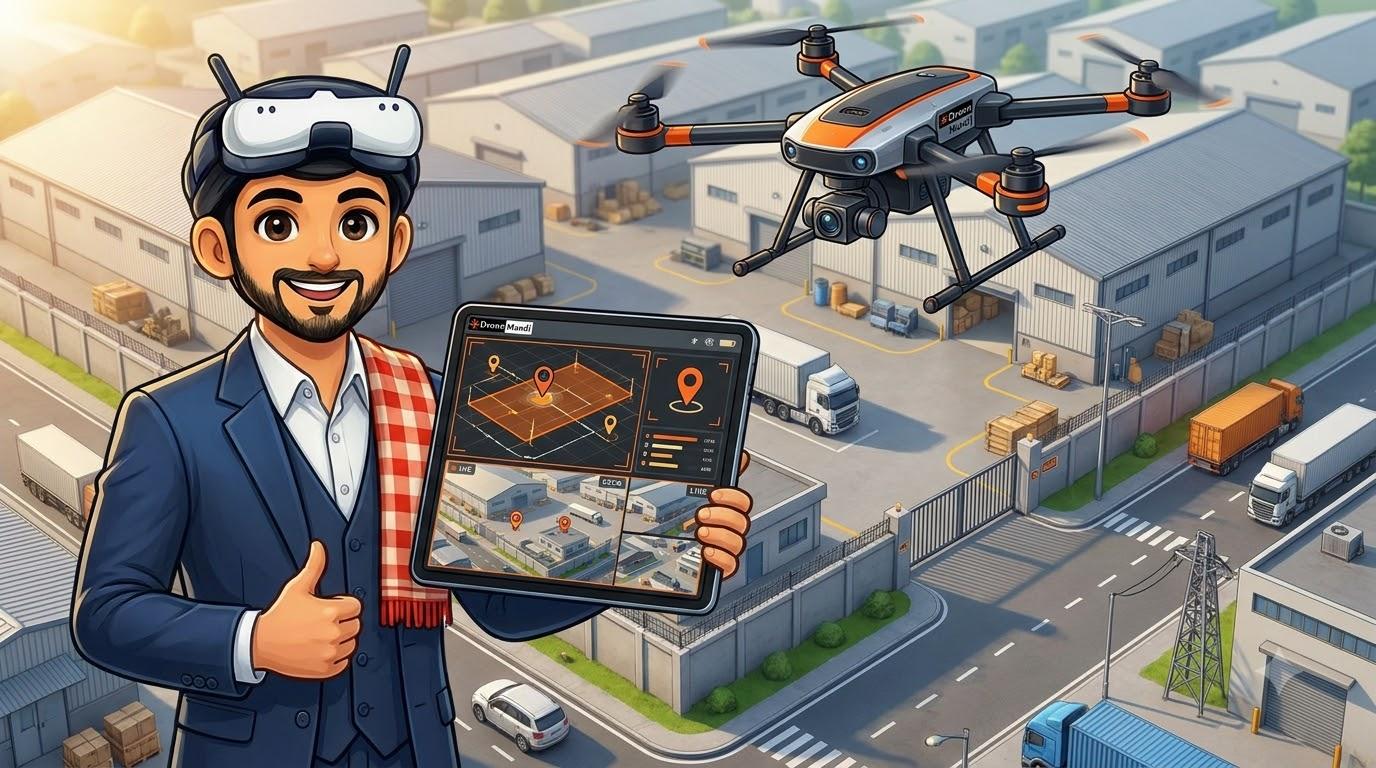
Drones provide another layer of aerial visibility. A professional drone can cover large areas from the air, capture high-resolution photographs or video and provide a mobile viewpoint that can be difficult to achieve with conventional ground-based monitoring.
This is why drone surveillance services in India are becoming increasingly relevant for businesses, infrastructure operators, construction companies, industrial facilities, large properties and other organizations that need aerial monitoring.
What Are Drone Surveillance Services?
Drone surveillance is the use of an unmanned aircraft to capture aerial visual information for monitoring a particular location, asset or activity.
Unlike a fixed CCTV camera, a drone can move around a site and change its viewpoint.
For example, a security or operations team may want to inspect the far end of a large industrial property. Instead of sending a person across the entire site, a drone can provide an aerial view of the area, subject to operational and regulatory requirements.
Depending on the application, drone surveillance can involve:
- Live aerial video
- High-resolution photographs
- Scheduled monitoring flights
- Perimeter monitoring
- Construction site monitoring
- Industrial site observation
- Infrastructure monitoring
- Thermal imaging for suitable applications
- Event and crowd observation
- Remote-area visual inspection
The exact capabilities depend on the drone, camera, operating environment and purpose of the project.
Why Are Businesses Using Drones for Surveillance?
Large sites can be difficult to monitor continuously from the ground.
A single facility may contain warehouses, boundary walls, parking areas, internal roads, equipment yards, storage areas and other sections spread across a large area.
Ground patrols remain important, but aerial monitoring can provide an additional perspective.
A drone can move quickly between selected areas and provide visual information from above. This can help operations and security teams understand what is happening across a wider area.
Common Applications of Drone Surveillance in India
1. Industrial Facility Monitoring
Factories, manufacturing plants and industrial facilities can cover substantial areas.
Drones can provide aerial visibility of selected external areas such as storage yards, access roads, rooftops, boundary areas and other suitable locations.
Regular flights can also create a visual record of site conditions.
2. Construction Site Surveillance
Construction sites are constantly changing and often contain valuable equipment, materials and machinery.
Aerial monitoring can provide an overview of the site, including material storage areas, access points, equipment locations and general site activity.
Drone surveillance can also complement construction progress monitoring by providing both operational and visual information.
3. Perimeter Monitoring
Large properties may have boundaries that are difficult to monitor efficiently from the ground.
A drone can be used to inspect selected portions of a perimeter from an aerial viewpoint.
This can be particularly useful for large industrial campuses, warehouses, infrastructure sites and other properties where the boundary covers a significant distance.
4. Warehouse and Logistics Facilities
Large logistics parks and warehouse facilities may contain extensive outdoor areas, vehicle movement zones and storage yards.
Drone-based monitoring can provide aerial visibility of these areas and support operations teams with additional visual information.
5. Infrastructure Monitoring
Infrastructure projects such as roads, bridges, rail corridors and other large assets can extend over significant distances.
Drones can capture aerial imagery from selected areas and provide a broader view than ground-level cameras.
This can be useful for visual monitoring, documentation and identifying areas that may require closer attention.
6. Event Monitoring
Large events can require an overview of entrances, parking areas, crowd movement and other external areas.
Where permitted and appropriately planned, drones can provide aerial footage and monitoring support.
Event drone operations require particularly careful consideration of people, flight paths, safety and applicable restrictions.
7. Agricultural and Large Land Monitoring
Large agricultural properties and remote land parcels can be difficult to monitor through frequent physical patrols.
Drones can provide aerial imagery of selected areas and help operators visually understand conditions across large properties.
8. Solar Plant Monitoring
Large solar installations can extend across substantial areas.
Drones can provide aerial visual documentation of panel fields, access roads, equipment areas and other external infrastructure.
Thermal drones can also support certain specialized solar inspection applications when the project requires temperature-based data.
9. Mining and Remote Industrial Sites
Mining and other remote industrial sites can contain large operational areas that are difficult to monitor continuously from the ground.
Aerial monitoring can provide additional visual information about selected areas of the site.
Drone Surveillance vs CCTV
Drone surveillance is not necessarily a replacement for CCTV.
The two technologies have different strengths.
| Factor | CCTV | Drone Surveillance |
|---|---|---|
| Position | Fixed camera locations | Mobile aerial viewpoint |
| Coverage | Limited to camera placement | Can move across selected areas |
| Large sites | May require many cameras | Can provide broader aerial visibility |
| Elevated view | Depends on installation | Natural aerial perspective |
| Continuous monitoring | Well suited | Depends on drone, operation and regulations |
| Mobility | Low | High |
For many businesses, the strongest approach may be to use CCTV for fixed continuous monitoring and drones for mobile aerial observation, inspection and periodic site checks.
Benefits of Drone Surveillance Services
Wide Aerial Perspective
A drone can provide an overview of a large site from above, making it easier to understand the relationship between different areas.
Mobile Monitoring
Unlike fixed cameras, a drone can be moved to different locations when a specific area needs to be observed.
Rapid Visual Assessment
For certain situations, aerial imagery can help a team quickly understand the condition of a large external area.
Reduced Need for Some Physical Patrols
Depending on the use case, drone flights can provide visual information about areas that would otherwise require personnel to travel across a large property.
This does not eliminate the need for security or operations personnel, but it can supplement their work.
Better Documentation
Drone photographs and video can create a record of site conditions that can be reviewed later.
Large-Area Monitoring
Drones can be particularly useful for properties where the area to be observed is too large for convenient ground-level visual monitoring.
Specialized Sensors
Certain drones can carry thermal or other specialized cameras, allowing them to support applications beyond ordinary visible-light video.
Can Drones Provide Live Surveillance?
Some professional drone systems can transmit live video to a ground operator or monitoring station.
The feasibility of live transmission depends on the drone platform, communication system, operating environment and project requirements.
For commercial applications, clients should discuss whether they need:
- Live video feed
- Recorded video
- Photographs
- Scheduled aerial checks
- Thermal imagery
- Event monitoring
- Periodic inspection reports
A live video requirement can involve different equipment and operational considerations compared with a simple aerial photography assignment.
Drone Surveillance for Construction Sites
Construction sites are one of the practical environments for drone-based monitoring.
A construction project may contain:
- Heavy machinery
- Construction materials
- Temporary structures
- Access roads
- Storage areas
- Multiple work zones
- Large perimeter areas
A drone can provide an aerial overview of these areas and support both security and project-management workflows.
For example, a construction company can combine regular progress flights with specific monitoring flights when operational teams need an aerial view of a particular section of the site.
This makes construction drone monitoring more than just photography. The same aerial platform can support documentation, surveying, mapping, inspection and other project requirements.
Drone Surveillance for Industrial Facilities
Industrial sites often have large external areas that can benefit from aerial visibility.
A drone may be used to visually monitor:
- Boundary areas
- Storage yards
- Warehouses
- Vehicle areas
- External equipment
- Access roads
- Roof areas
- Selected infrastructure
Industrial drone operations require careful planning because the environment can include cranes, power infrastructure, structures, machinery and other potential hazards.
The operator should understand the site before conducting the flight and coordinate with the facility team where required.
Thermal Drone Surveillance
Thermal cameras can detect differences in infrared radiation and provide information that is different from ordinary visible-light imagery.
Thermal-equipped drones may be useful for certain industrial, infrastructure, solar, building and monitoring applications.
However, thermal imaging should not automatically be interpreted as a security or inspection conclusion.
Environmental conditions, camera specifications, surface characteristics and operating conditions can affect thermal data.
If a project requires thermal surveillance or inspection, the service provider should understand the specific objective and select appropriate equipment and operating conditions.
How Much Does Drone Surveillance Cost in India?
There is no fixed nationwide price for drone surveillance services in India.
Pricing depends on whether the requirement is a one-time aerial monitoring assignment, recurring surveillance, live video, thermal monitoring or a larger commercial operation.
| Requirement | Main Pricing Factors |
|---|---|
| One-time aerial monitoring | Location, flight duration, drone and deliverables |
| Construction site monitoring | Site size, frequency and reporting requirements |
| Industrial surveillance | Site complexity, equipment and operating conditions |
| Live aerial feed | Drone platform, transmission system and operator requirements |
| Thermal monitoring | Thermal equipment, flight requirements and processing |
| Recurring surveillance | Frequency, duration, site size and service scope |
For standard drone services in India, basic camera-drone assignments may often fall around ₹5,000–₹8,000 per session or approximately ₹9,000–₹13,000 per day, depending on location and scope.
Advanced drones and specialized equipment can cost approximately 1.5–2 times standard drone rates.
For surveillance projects involving recurring flights, thermal equipment, live transmission or large industrial sites, it is generally better to request a project-specific quotation.
These figures are practical planning ranges rather than fixed nationwide tariffs.
What Determines Drone Surveillance Cost?
- Site size: Larger areas require more flight planning and operating time.
- Location: Travel and logistics can affect the price.
- Flight duration: Longer assignments may require additional batteries, equipment or operating time.
- Frequency: Recurring monitoring involves multiple scheduled visits.
- Drone type: Professional and advanced drones have different operating costs.
- Camera: Specialized cameras such as thermal systems can increase the cost.
- Live transmission: Live-feed requirements can require additional equipment and planning.
- Reporting: Analysis, documentation and reporting may add to the project scope.
- Site complexity: Industrial environments and congested areas may require additional planning.
How to Hire a Drone Surveillance Service in India
Hiring the right drone surveillance provider starts with clearly defining what you need to monitor.
Step 1: Define the Area
Identify the property, facility, construction site, infrastructure or land area that needs monitoring.
Step 2: Define the Purpose
Explain why you need aerial monitoring.
For example:
- Perimeter observation
- Construction monitoring
- Industrial site monitoring
- Asset documentation
- Event monitoring
- Periodic visual checks
- Thermal monitoring
- Large-area observation
Step 3: Decide What You Need Delivered
Tell the provider whether you require photographs, recorded video, live video, thermal imagery, scheduled reports or another specific output.
Step 4: Share the Location
The exact location is important for evaluating the feasibility of the operation, surrounding environment and applicable drone operating requirements.
Step 5: Discuss the Equipment
Ask what drone and camera will be used and why they are appropriate for the requirement.
A standard camera drone may be sufficient for general monitoring, while large industrial or specialized projects may require more capable equipment.
Step 6: Check Pilot Experience
Commercial drone monitoring should be handled by an appropriately experienced professional who understands the equipment, site conditions and operational requirements.
Step 7: Discuss Safety and Permissions
Before the operation, the provider should evaluate the site and follow applicable drone regulations and safety procedures.
For industrial and commercial properties, the site owner may also have its own security, access and safety requirements.
Step 8: Compare the Complete Service
Do not compare providers based only on the price of the flight.
Consider equipment, operator experience, travel, flight duration, live transmission, imagery, processing and reporting when comparing quotations.
Why Use Drone Mandi for Drone Surveillance?
Finding the right drone operator for a surveillance requirement can be difficult because different projects require different equipment and operating approaches.
A construction site may need regular aerial monitoring, while an industrial facility may need thermal imagery or a specific live-video workflow.
Drone Mandi is an Indian drone marketplace designed to help customers connect with drone professionals for different commercial drone requirements.
Instead of searching separately for a drone, pilot and service provider, customers can describe their requirement and find a suitable professional for the project.
Drone Mandi can be used for requirements such as:
- Drone surveillance
- Construction monitoring
- Drone inspection
- Drone mapping
- Drone surveying
- Drone photography
- Drone videography
- Industrial drone services
- Custom drone services
This broader ecosystem can be useful when a business needs more than one type of aerial service during a project.
Looking for a Drone Surveillance Service?
Need aerial monitoring for a construction site, industrial facility, warehouse, large property, infrastructure project or another commercial requirement?
Drone Mandi helps customers connect with drone professionals for surveillance, inspection, mapping, surveying, photography and other aerial services across India.
Share your requirement and find the right drone professional for your project.
Drone Surveillance Services in Major Indian Cities
Businesses across India's major commercial and industrial cities can use drone-based monitoring for a variety of applications.
- Gurgaon: Corporate campuses, construction sites, commercial properties and industrial facilities.
- Delhi: Infrastructure, commercial properties, institutions and large sites.
- Noida: Construction, industrial facilities, warehouses and commercial developments.
- Bangalore: Technology campuses, industrial sites, construction and large properties.
- Mumbai: Infrastructure, construction, industrial facilities and large commercial properties.
- Pune: Manufacturing, industrial and construction applications.
- Chennai: Industrial facilities, logistics, infrastructure and construction projects.
- Ahmedabad: Manufacturing, industrial sites and large commercial properties.
- Hyderabad: Technology campuses, construction and industrial applications.
- Other Indian cities: Availability depends on the project location, operator network and operating requirements.
Drone Surveillance for Large Properties
Large properties can be challenging to monitor because security teams need visibility across multiple areas.
A drone can provide aerial imagery of selected sections of the property and help teams understand the overall site layout.
For example, a large warehouse facility may require monitoring of its parking area, storage yard, perimeter and access roads.
Instead of treating each area separately, an aerial view can provide a broader operational picture.
Drone Surveillance for Remote Areas
Some sites are located far from urban centres or contain sections that are difficult to access frequently.
Aerial monitoring can reduce the need for personnel to physically travel across every section simply to obtain a visual overview.
However, remote locations can also create additional operational challenges, including communication, weather, battery management and emergency planning.
The service provider should evaluate these factors before conducting the operation.
Limitations of Drone Surveillance
Drones are powerful monitoring tools, but they have limitations.
- Flight time is limited by battery capacity and operating conditions.
- Weather can affect operations.
- Some locations may have operating restrictions.
- Obstacles can make flight planning more difficult.
- Live transmission depends on the communication system and environment.
- Night operations may require additional planning and compliance considerations.
- Drones cannot automatically identify every security incident.
- Human operators and existing security systems may still be necessary.
Understanding these limitations helps businesses design realistic drone surveillance programs rather than expecting one drone to replace an entire security system.
Drone Surveillance and Privacy
Businesses using drones for monitoring should also consider privacy and responsible data handling.
The purpose and operating area should be clearly defined, particularly when a drone may capture imagery beyond the intended property.
Organizations should establish appropriate procedures for storing, accessing and using recorded imagery.
For operations near residential areas, public spaces or events, additional care should be taken to avoid unnecessary capture of individuals and to comply with applicable requirements.
How Drone Surveillance Is Evolving
Drone surveillance is gradually moving from occasional aerial photography toward more structured monitoring workflows.
Businesses can combine drone imagery with recurring inspections, mapping, thermal data and other digital information.
For example, an industrial facility could establish a recurring aerial monitoring program where selected areas are captured on a predefined schedule.
Over time, this creates a visual history of the site rather than a collection of unrelated drone photographs.
The future of commercial drone monitoring is therefore likely to involve a combination of drones, sensors, software, analytics and existing security infrastructure.
Common Mistakes When Hiring Drone Surveillance Services
Hiring Only Based on Price
A cheap drone flight may not include the equipment, operator experience or monitoring workflow needed for a professional commercial requirement.
Not Defining the Monitoring Area
The provider needs to know the approximate area and specific locations that need to be observed.
Confusing Surveillance With Photography
Aerial photography and surveillance have different objectives. Surveillance may require recurring flights, live video, specific viewpoints or operational coordination.
Ignoring Equipment Requirements
A basic camera drone may not be suitable for a requirement involving thermal imaging, long-range observation or specialized data collection.
Expecting Continuous Monitoring From a Single Drone
Most commercial drones have practical limits related to battery life, operating conditions and flight regulations. A surveillance program should account for these limitations.
Not Planning the Data Workflow
If video or photographs are being recorded, decide in advance how the data will be delivered, stored and reviewed.
When Should a Business Consider Drone Surveillance?
Drone surveillance can be worth considering when a business needs an aerial perspective over a large or difficult-to-monitor area.
It may be particularly useful when:
- The property is large.
- Ground patrols cover significant distances.
- There are difficult-to-access external areas.
- Management needs periodic aerial visibility.
- A construction site requires regular monitoring.
- An industrial facility needs additional visual documentation.
- A specialized thermal monitoring application is required.
- Existing CCTV provides insufficient aerial perspective.
Frequently Asked Questions
What are drone surveillance services in India?
Drone surveillance services use professional drones equipped with cameras or specialized sensors to provide aerial monitoring of properties, construction sites, industrial facilities, infrastructure and other defined areas.
How much does drone surveillance cost in India?
Cost depends on the site size, location, drone equipment, flight duration, monitoring frequency, live-feed requirements, specialized sensors and deliverables. Commercial surveillance projects are generally quoted according to their specific scope.
Can drones provide live surveillance?
Some professional drone systems can transmit live video to a ground operator or monitoring station. The feasibility depends on the drone, communication system, operating environment and project requirements.
Can drones monitor construction sites?
Yes. Drones can provide aerial monitoring of construction sites and can also support progress documentation, inspection, surveying and mapping workflows.
Can drones be used for industrial surveillance?
Yes. Drones can provide aerial visibility of selected external areas of industrial facilities, including storage yards, boundaries, access roads, warehouses and other suitable locations.
Can drones be used for perimeter monitoring?
Yes. Drones can provide an aerial viewpoint of selected perimeter areas and can complement ground patrols and fixed security systems.
Can thermal drones be used for surveillance?
Thermal drones can support certain applications where temperature-related information is useful. The appropriate drone and sensor depend on the specific monitoring requirement.
Can drones replace CCTV?
Usually, drones are better treated as a complementary monitoring tool rather than a complete replacement for CCTV. Fixed cameras provide continuous coverage while drones provide mobile aerial visibility.
How do I hire a drone surveillance company in India?
Share the location, area to be monitored, purpose, frequency, required camera or sensor and desired deliverables with a professional drone service provider. Drone Mandi can help customers connect with drone professionals for surveillance and other commercial drone requirements.
Can I book drone surveillance near me?
Drone surveillance services may be available in different Indian cities depending on operator availability, project requirements and operating conditions. You can submit your requirement through Drone Mandi to find a suitable drone professional.
Conclusion
Drone surveillance is becoming a useful additional layer for businesses that need aerial visibility across large properties, construction sites, industrial facilities, infrastructure projects and other difficult-to-monitor areas.
Unlike fixed cameras, drones can move around a site and provide a mobile aerial perspective. This makes them useful for periodic monitoring, visual documentation, inspections and selected specialized applications.
However, successful drone surveillance depends on much more than the aircraft itself. The operator, camera, flight plan, site conditions, data workflow, safety procedures and applicable operating requirements all need to be considered.
For businesses looking for professional drone surveillance services in India, Drone Mandi provides a marketplace approach to finding drone professionals for surveillance, construction monitoring, inspections, mapping, surveying, photography, videography and other aerial requirements.
Need Drone Services?
Get in touch with us to book certified drone pilots anywhere in India.